The first question I tend to get from friends landing at Narita is, almost word for word, the same: “Is Yoshiwara actually safe — health-wise?” The honest answer is that the truth sits between the Reddit panic and the cheerful blog posts that lean on a single twenty-year-old paper. What follows is the conversation I’d have with a friend over a coffee at the Café — the 2026 numbers, the structural safeguards Japan quietly has in place, the gaps that genuinely remain, and the small set of decisions that move your real-world risk from “background noise” to “vanishingly small.”
Why this matters

English-language coverage of Japan’s adult entertainment tends to split into two unhelpful camps. The first ports over a generic “Asian red-light district equals high HIV” assumption that hasn’t been true for decades — Japan’s new HIV diagnoses are roughly an order of magnitude lower than in many Southeast Asian destinations and sit near the bottom of developed-world tables. The second leans on a single 2003 PubMed study and quotes its numbers as if they were yesterday’s.
Neither camp tells a visitor in 2026 what actually matters: the type of establishment you choose, the category of STI in play, and the protocol you follow before and after a visit. Get those three right and your real-world risk in Yoshiwara’s mid- to upper-tier bathhouses sits closer to a serious date in London than to the cautionary tale your friends imagine.
Four myths I’d like to retire

Before we get to the numbers, four stubborn misunderstandings I see in almost every English-language thread.
Myth #1: “Soapland is unregulated and underground”
It isn’t. Yoshiwara’s bathhouses are registered under Japan’s Businesses Affecting Public Morals Regulation Act as private-room bathing businesses, known to the local police, and inspected by the public health authorities. Whatever you make of the legal framework that powers the industry, the buildings themselves operate in plain daylight — with addresses, licensed operators, and an inspection schedule. That puts them in a structurally different universe from the genuinely high-risk corners of Japan’s night economy: unlicensed apartment-room operators, street-based solicitation, and social-media-arranged private encounters.
Myth #2: “All Asian red-light districts are HIV-heavy”
Japan’s HIV incidence is roughly an order of magnitude lower than in many Southeast Asian destinations. The category that has actually surged in Japan is syphilis — a different organism with a different transmission profile, and as we’ll see, one whose increase tracks a very specific subset of the industry rather than the bathhouses.
Myth #3: “If syphilis is up nationally, soaplands must be the source”
This is the misreading I’d most like to dismantle. A 2026 ecological study published in PMC (PMC12127005) found the strongest statistical association between male syphilis incidence and non-store-based delivery services — Japan’s deri-heru, where the worker travels to a hotel or residence — not store-based bathhouses. The underlying reason is unglamorous and structural: store-based premises have addresses, operators, and inspection schedules. Off-site delivery work, by its nature, doesn’t. That asymmetry shows up in the numbers.
Myth #4: “All Japanese soaplands operate condom-free”
This is the most dangerous myth, and it’s flatly wrong. The default at established Yoshiwara houses — and the explicit industry norm for foreign visitors — is condom-on. So-called “NS” (no skin = no condom) services do exist, they are increasingly marketed by competitive shops aimed at Japanese clients, and they are exactly where the additional risk sits. But the foreigner-friendly tier operates on a condom-required basis as a matter of standing house rule. The “Japan equals raw” urban legend that travels around English forums simply doesn’t match how foreigner-facing shops actually run.
What the numbers actually say
The reassuring side first. Japan’s HIV incidence sits near the bottom of developed-country tables. The 2003 soapland study found zero HIV-positive workers in its sample of 135, with syphilis at 4.4% and Chlamydia at 8.9% rounding out the picture. Those figures are now over two decades old — treat them as a historical baseline, not a present-day reading — but current rates among mid- and upper-tier Yoshiwara workers are likely lower, not higher, thanks to today’s self-screening culture.
The uncomfortable side. Syphilis nationally is at a multi-decade high — roughly 14,700 cases in 2024 across Japan, and projections suggest 2025 will land above 13,500. The encouraging caveats: a meaningful share of new cases comes from outside the licensed industry entirely (casual encounters via apps, in particular), and as noted above, the by-business-type analysis points harder at delivery services than at bathhouses.
And the most important fact of all. The places where STI risk is genuinely high in Japan are unlicensed operators, street-based solicitation, and social-media-arranged private encounters. No screening protocol. No documented condom-use rates. No traceable operator. None of the structural risk controls that licensed premises carry. Yoshiwara’s registered bathhouses sit at the opposite end of that spectrum.

Per-encounter risk & condom protection
Rough ranges from the public-health literature. Condom protection figures are for correctly-applied condoms.
| Infection | Per encounter | Per act | 🛡️ Condom |
|---|---|---|---|
| HIV | ~0.016% | ~0.1% | ~95% |
| Syphilis | ~0.32% | ~1% | ~90% |
| Gonorrhoea | ~7% | ~47% | ~60% |
| Chlamydia | ~16% | 30–50% | ~90% |
| Pharyngeal (oral) | — | 25–30% | partial |
The takeaway: HIV — the most life-altering infection on this table — is also the one a correctly-applied condom blocks most completely. The worst case is structurally defused before you even choose the act.
How to read condom protection: the three-tier mental model
Lead with the most important point: the most catastrophic infection on this list — HIV — is the one a correctly-used condom blocks most completely. HIV is a lifelong, expensive, life-changing diagnosis. A correctly applied condom blocks roughly 95% of HIV transmission, with the residual 5% coming from breakage and application error rather than from the act itself. In other words: before you’ve even chosen the act, the worst-case scenario is already structurally defused.
Split protection into three tiers and the picture clarifies fast.
🟢 Tier 1 — Almost entirely blocked (90%+)
- HIV: ~95%
- Syphilis: ~90%
- Chlamydia: ~90%
This tier covers the infections that genuinely rewrite a life. With a condom, almost all of “the things that could derail your career and relationships in one evening” land here, behind the latex.
🟡 Tier 2 — Partially blocked (around 60%)
- Gonorrhoea: ~60%
Gonorrhoea spreads across a larger mucosal contact area than a condom can fully cover. The reassuring piece: gonorrhoea is curable with antibiotics, and early detection prevents nearly all long-term consequences. If you keep to the testing cadence outlined below, your practical risk lives well inside the manageable zone.
🔴 Tier 3 — Only partial protection (skin-contact spread)
- HPV (human papillomavirus)
- Genital herpes (HSV-1/2)
These spread through skin areas a condom can’t cover. But “partial protection” isn’t the end of the conversation — for both, there are real treatment and prevention paths:
- HPV: Roughly 90% of infections self-clear within two years. The 9-valent vaccine (Gardasil 9 / Silgard 9 in Japan) prevents almost all serious strains and is available out-of-pocket in Japan for adults up to 45.
- Genital herpes: Antiviral medication keeps outbreaks well controlled. Most people with herpes live ordinary lives without serious daily impact.
The headline: the most feared infection (HIV) is the one a condom handles best. Everything else has a treatment, a vaccine, or a testing protocol that brings it back into the manageable zone.
Why Yoshiwara is safer than its reputation suggests
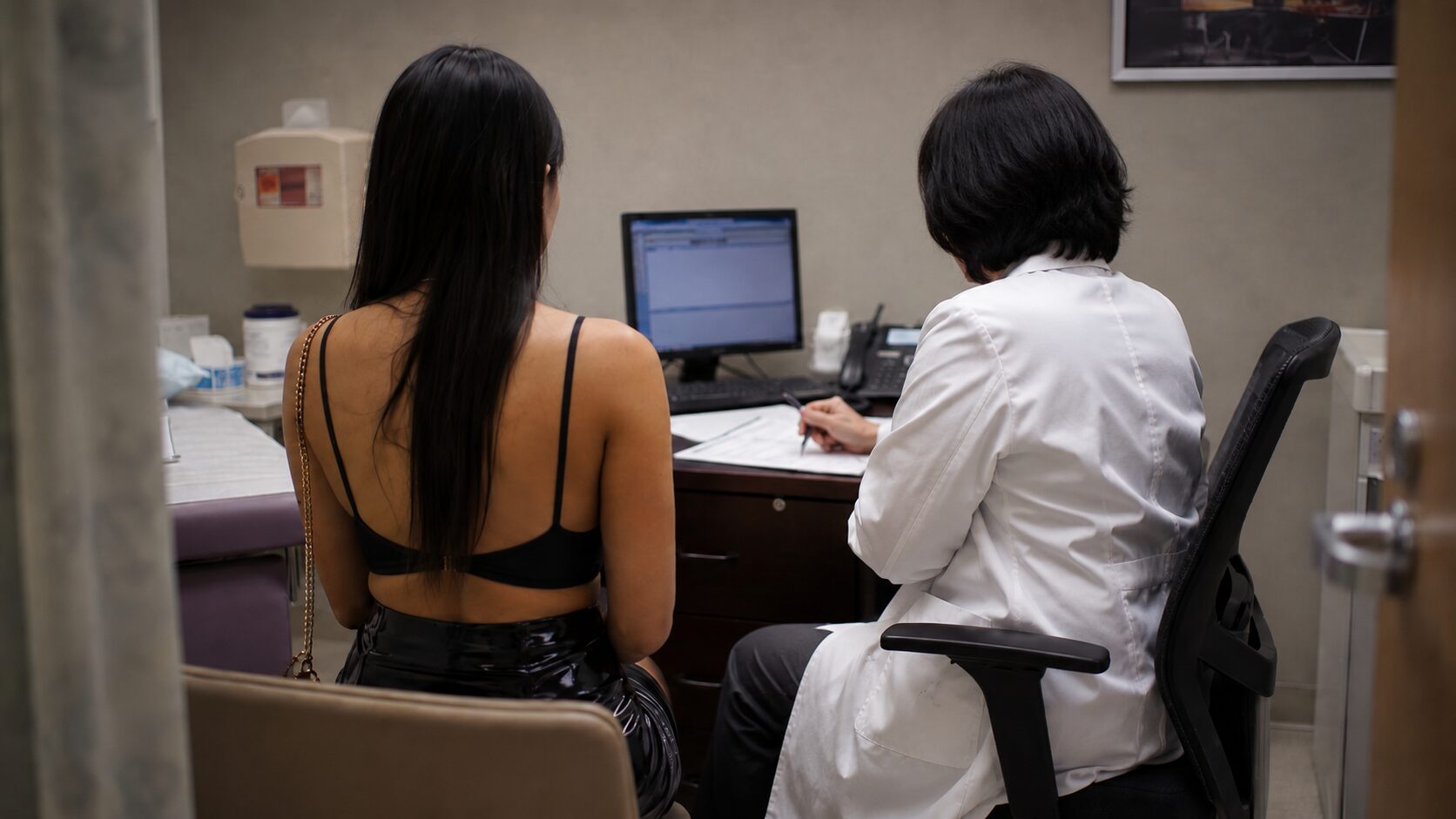
Four Japan-specific structural features push Yoshiwara into a lower-risk band than the foreign press tends to acknowledge.
1. The legal frame
Bathhouses operate under the Businesses Affecting Public Morals Regulation Act as registered private-room bathing businesses. That means a real address, an identifiable operator, and a regular inspection schedule by police and public health authorities. As noted above, where STI risk genuinely concentrates in Japan is in unlicensed operators, street-based solicitation, and social-media-arranged private encounters — exactly the formats that fall outside any registration or inspection regime. Licensed bathhouses sit at the opposite end of that spectrum.
2. Worker-side clinical infrastructure — and this is the Yoshiwara-only edge
The Shin-Yoshiwara Health Clinic, operated by Medical Corporation Shin-Yoshiwara-kai, exists specifically for the women working in the district. All-female staff. HIV-focused screening panels. An ecosystem the worker community has trusted for decades.
“This clinical infrastructure, combined with the industry-customary monthly health check, exists at this level of organisation only in Yoshiwara.
The other major historical districts in Japan — Kawasaki Horinouchi, Kanazu-en, Ogoto, Fukuhara, Nakasu — do not have an equivalent dedicated clinic or the same monthly screening culture, and delivery health, “image clubs,” and similar formats have nothing comparable at all. This single piece of infrastructure is one of the strongest reasons to prefer Yoshiwara over any other adult entertainment format in Japan if you’re optimising for health safeguards.
Two honesty notes: the clinic screens workers, not clients — clients use general STI clinics, listed further down — and participation is industry custom rather than a legal mandate, so compliance is highest in mid- and upper-tier shops and thins out at the bottom of the price spectrum.
3. The condom-required rule for foreign visitors
At mid- and upper-tier foreigner-friendly bathhouses, condom-on is operated as a house rule without exceptions for foreign clients. Even shops that offer condom-free services to Japanese regulars typically maintain a condom-required policy specifically for foreign visitors. In practice this functions as a safety baseline that you don’t have to negotiate.
4. The worker’s refusal right — the safeguard that runs in both directions
The protection runs both ways. A worker can — and is expected to — refuse penetrative service if the client shows any visible lesion, swelling, lump, sore, or unusual odour during the pre-session shower check. That pre-session inspection is standard procedure, not an option. The route where a client unknowingly becomes the source of an infection is partly closed off here, by the worker, in your interest as well as hers.
Stack those four layers together — registered premises, worker-side clinical infrastructure unique to Yoshiwara, condom-required house rules for foreigners, and the worker’s refusal right — and the real-world risk profile of a mid- or upper-tier Yoshiwara visit sits materially below a bar pickup, an app encounter, and certainly below anything you’d find in the unlicensed corners of the industry. Materially below — not zero.
What the safety story leaves out

If I leave you here you’d have an unrealistically clean picture. The safeguards above are real, and they stack, but they’re not airtight. Three honest gaps.
Gap 1: NS (condom-free) shops exist and are growing
An interview with a soapland operator in FRIDAY DIGITAL put it bluntly: demand from Japanese clients for condom-free service has risen, competitive pressure has pushed more shops to offer it, and that quiet shift is doing real work in Japan’s syphilis numbers. The good news for you as a foreign visitor is that the condom-required rule discussed above acts as a shield.
Shops which actively market “NS available” or “NN on request” tend to have thinner safety discipline overall — not just on condoms — so even foreign visitors are well advised to avoid them entirely. Read “NS available” not as a perk, but as a warning label.
Gap 2: The client as the source
The transmission path “client to worker” is real, and you can be part of it without knowing. The pre-session shower check catches visible lesions, but early-stage syphilis and asymptomatic gonorrhoea or Chlamydia are invisible to the naked eye. Clients who quietly carry an infection without symptoms do exist. The two practices that matter here — a baseline panel at home before you fly and a clean post-visit testing cadence — protect the worker as well as you.
Gap 3: The structural limit of monthly screening
A worker screened on the first of the month who picks something up on the second won’t be flagged until the next cycle. Monthly screening is a population-level public health tool — it manages the industry’s overall infection profile — not a real-time guarantee for tonight’s appointment. This isn’t a Yoshiwara-specific limitation; it’s a limitation of the monthly model. The takeaway is to read the safeguards as a system: registered premises plus worker screening plus condom rules plus your own pre/post protocol. Any one of them alone is incomplete. Stacked together, they bring the real-world risk down to a level the panic doesn’t justify.
Prevention checklist
The practical layer. What I’d actually do, in order.
Before you fly
- Get a baseline STI panel at home — HIV, syphilis, gonorrhoea, Chlamydia, hepatitis B. It costs little and gives you a clean reference point if anything turns up later.
- If you’re under 45 and haven’t completed the HPV vaccine series (Gardasil 9 / Silgard 9), finish it. It’s the only intervention on this list that a condom can’t replicate — HPV spreads through skin contact areas latex doesn’t cover.
Choosing a shop
- Stay in Yoshiwara’s mid-to-upper tier. The lowest price band is where both discipline and safety margins thin out.
- Avoid shops that market NS or NN options, including the “available on request” wink.
- If you can’t read the Japanese signalling on shop sites, an English-speaking intermediary saves time. The Soapland Guide Café is a free service that exists exactly to steer foreign visitors past this trap — there is no fee beyond what you pay the shop directly.
On the day
- Use the condom the shop provides. Carrying your own is not standard practice and is generally discouraged — see the FAQ below for the full reasoning.
- Decline any attempt to remove the condom during the session — yours or hers.
- If a worker has any visible oral lesion, skip deep kissing.
- If you notice anything off about your own body — swelling, a lump, a sore, redness — check it at a clinic before arriving. Same-day refusals at the shower stage usually mean no refund.
- Note on tipping: tipping is not customary in Japan and can actively confuse staff. The price you book is the price.
Post-visit testing cadence
- HIV antigen/antibody testing becomes reliable at about four weeks.
- Syphilis serology at three to six weeks.
- Gonorrhoea and Chlamydia NAATs at one to two weeks.
- A sensible foreign-visitor cadence is a quick check at 2–3 weeks and a confirmatory full panel at 8–12 weeks.
If you’re worried after a visit
Treat this section as a calm checklist, not a crisis.
Within 72 hours, if you have specific reason to fear HIV exposure — a broken condom, a partner you later learn was at elevated risk — HIV PEP (post-exposure prophylaxis) is available in Tokyo from clinics that handle sexual-health emergencies. The clock is real: effectiveness drops past 72 hours and becomes essentially nil past 96. Phone first; do not wait for a routine appointment slot.
English-speaking testing options in Tokyo
Confidentiality at all of these is the standard, not the exception. None of them will involve your hotel, your embassy, or your employer in your testing.
Symptoms to take seriously: a painless ulcer (chancre) anywhere from the genitals to the lip, an unexplained body or torso rash 6–10 weeks after exposure, urethral discharge, or a throat pain that won’t resolve. The tricky thing about early-stage syphilis is that its first symptoms vanish on their own, which patients often misread as healing. It is not healing. Tested early and treated, syphilis is fully curable with antibiotics.
Frequently Asked Questions

- Is a Yoshiwara soapland visit safe from STIs?
Lower-risk than most foreign visitors assume, but not zero. The combination of licensed premises, worker-side screening through the Shin-Yoshiwara Health Clinic, condom-required rules for foreign clients, and the worker’s refusal right at the pre-session shower check places a mid- or upper-tier Yoshiwara visit in a materially safer band than casual encounters or unregulated services. The three conditions: keep the condom on, avoid shops that market NS, and follow a sensible testing cadence afterwards.
- Do soapland workers really get tested every month?
At mid- and upper-tier Yoshiwara shops, most workers participate in the industry-customary monthly health check, with the Shin-Yoshiwara Health Clinic providing HIV-focused screening panels for women in the district. It is industry custom rather than a legal requirement, so adherence is tightest at the higher-tier shops. Crucially, this monthly screening culture and the dedicated clinic exist at this level of organisation only in Yoshiwara — Kawasaki Horinouchi, Kanazu-en, Ogoto, Fukuhara, Nakasu, and other formats like delivery health do not have equivalent infrastructure.
- Should I bring my own condoms?
Generally no. The shop and the worker supply condoms by default, and workers tend to distrust client-brought condoms — there’s a real concern in the industry about clients tampering with their own condoms (puncturing the latex to defeat contraception and STI prevention), so refusing brought-in condoms is a standard self-protective practice across the industry.
The exception: if you’re meaningfully above the average size for Japan and a standard local condom won’t fit safely, you can bring a larger (“BIG” size) condom — these are sold at any Japanese convenience store nationwide (7-Eleven, FamilyMart, Lawson).
Critical rule when bringing your own: bring the full, unopened box — do not break the plastic shrink-wrap, let alone unwrap individual condoms in advance. Even a single individually-wrapped condom brought separately can be refused on tampering grounds. The box gets opened in front of the worker, by the worker. That’s the protocol.
- Are NS or NN services common in Yoshiwara?
Some shops actively market them; most do not. And critically, those that do are aimed primarily at Japanese clients — foreign visitors are typically subject to the condom-required rule regardless of what the shop offers Japanese regulars. For a foreign visitor, “NS available” should be read not as a perk but as a practical warning label: it correlates with thinner safety discipline overall.
- Is delivery health (deri-heru) safer or riskier than a soapland?
The 2026 PMC study (PMC12127005) found a stronger statistical association between male syphilis incidence and non-store-based delivery services than with store-based bathhouses. Store premises are easier to inspect; off-site work is not. For a visitor optimising for the cleanest available compliance environment, a registered bathhouse is the more conservative choice — and Yoshiwara is the only district where the worker-side monthly screening culture is organised around a dedicated clinic.
- What about street-based or unlicensed operators?
This is where the genuine STI risk in Japan lives. No screening, no documented condom use, no traceable operator, no recourse if something goes wrong. The licensed bathhouses of Yoshiwara are a structurally different category, and English-language commentary that lumps them together with unregulated street-level activity is making a serious categorisation error.
- If I have a rash or lesion on my penis, can I still enter?
Almost certainly not. The worker will refuse penetrative service at the pre-session shower check, and many shops will not refund the appointment fee in that situation. Checking at one of the English-speaking clinics listed above before your visit is by far the cheaper option.
- I removed the condom for part of the visit. Is PEP an option?
If the concern is specifically HIV and you are inside 72 hours of the exposure, yes — call a clinic that handles emergency sexual health (Personal Health Clinic is the most reliable English-speaking starting point). Past 96 hours the window has effectively closed. PEP is a 28-day course, not a single pill, and is best started within 24 hours where possible.
- Where can I get tested in English in Tokyo after a visit?
Personal Health Clinic (Yushima/Ueno), Private Care Clinic Tokyo (West Shinjuku), Ginza Hikari Clinic, GOETHE Clinic (Ikebukuro), and Tokyo Business Clinic all handle English-speaking patients. Anonymous and walk-in options exist at several. Run a 2–3 week early check and an 8–12 week confirmatory panel.
- Do I need to bring my passport?
Yes, in many cases. Foreign visitors are commonly asked to show a passport at the door, and a visa stub or residence card is sometimes also requested. Booking through an English-speaking intermediary like the Soapland Guide Café smooths this — you arrive at a shop that already expects you, with the language and ID procedures handled in advance.
Bottom line
The gap between Yoshiwara’s English-language reputation and its actual real-world risk profile is large, and it cuts in the visitor’s favour more often than not. A registered, mid- or upper-tier bathhouse, paired with the worker-side screening infrastructure that exists at this organisational level only in Yoshiwara, the condom-required rule for foreign clients, the worker’s refusal right at the shower stage, and a deliberate decision not to chase shops that wink at NS — that combination places real-world risk in a band the panic simply doesn’t justify.
Not zero. Syphilis is genuinely up nationally. HPV and herpes are not problems a condom fully solves. Monthly screens are not hourly screens. None of that goes away. The visitor who treats the safeguards as one system — licensed premises, worker screening, condom rules, and personal pre/post protocol — gets the most of what Yoshiwara offers and pays the least of what it occasionally costs.
If you’d like a hand picking a shop that stays well inside the safer band — and steering past the ones that quietly don’t — that’s exactly what the Soapland Guide Café exists for. English-speaking, free, no fees beyond what you pay the shop.